As an Amazon Associate I earn from qualifying purchases. Thank you for supporting this site by purchasing through the links below!
Wiring A Coro Prop – Including Singing Props
First – Setup The Prop in xLights
- Open xLights to the correct show folder that you want to prop to be part of
- Switch to the “Layout” tab in xLights
- Most props will come with a file called an “xmodel”, which you usually download from the prop vendor’s website — download this file and drop it into a folder that’s easy to find
- If your prop doesn’t come with an xmodel, it may be a prop that’s a native shape for xLights, like a star
- If this is the case, you will need to create a native xLights model using the icons at the top of the layout tab
- Create a new model by clicking the Import Button in the model icons in the layout visualization window on the right
- After clicking the icon, click and drag your cursor on an open area of the layout to create a square where you want the prop — you can always move and resize it later
- You will get a pop-up window asking you to “choose model file” — choose the xmodel file you downloaded in step 3
- Over in the models list of the left, you should see the new model named whatever the xmodel creator specified (for example “small spinner” or something) – I will call it “new model” for the rest of this tutorial
- Click on the “new model” name in the list on the left
- At the bottom left, you will see all of the settings for “new model”
- Rename the model, if desired, by changing it in the settings box (name is first item)
- Strings should be set to 1 (even if you have multiple physical strings of lights — for example a 200 light spinner could have 4 sets of 50 lights daisy chained together)
- Hit save (red button at bottom of screen)
- The prop is now set up in xLights! Now you can wire it (push pixels)!
Second – Assign The Prop To A Controller Port
- In the xLights controller tab, click the name of the controller you want to assign the prop to
- Click “visualize” – a window will pop up
- Click and drag the name of the prop on the right side to the desired port on the left side
- You can assign multiple props to the same port if you plan to daisy chain them together
- Make sure that you drag them in the correct order (same as physical wiring)
- Make sure you have enough power based on the number of pixels; inject power if needed
- Click the red “save” button over on the far left of the screen
Third – Wire the prop aka “pushing pixels”
- In the xLights layout tab, click the name of the prop
- Right click the prop name and choose “wiring view” from the menu
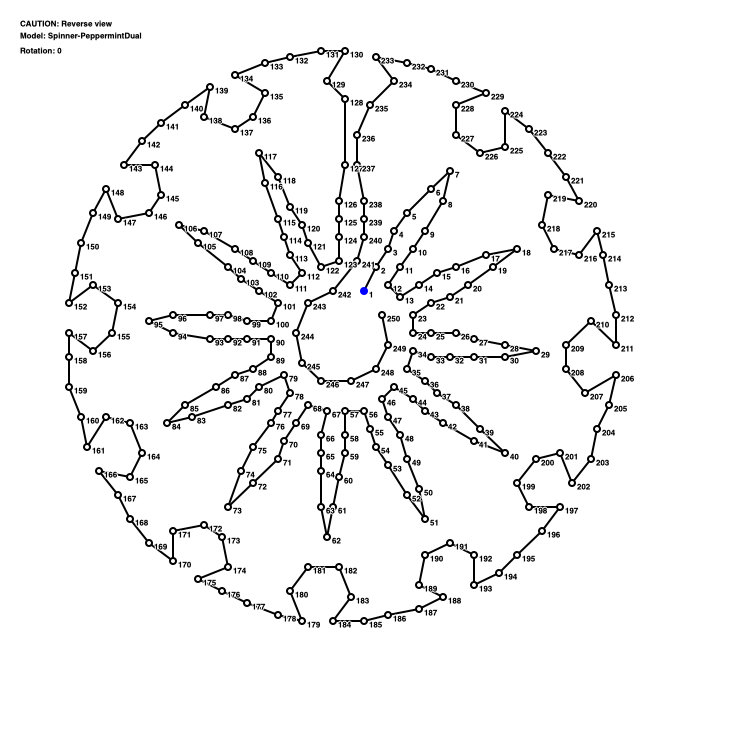
- You will see a popup of the prop’s wiring diagram — this is the reverse view (looking at the back of the prop), since this is how you will push the lights through the coro
- You can choose to work off the screen (you should probably maximize the view) or I sometimes choose to print the wiring diagram:
- Right click the diagram and set the color scheme to “light” — which will give you black on white
- Right click and set it to “smaller font” (this keeps node numbers from getting bunched together)
- Right click again and say “export” (I have not had good luck printing directly from xLights)
- Go open the .png file of the model you just exported, and you can print from there
- See examples below of 250 pixel spinner, xmodel and test video
- Now you can start wiring — be very careful to find pixel #1 on the back of your physical prop and ensure you are starting at the right place — if you don’t, you will be tearing it apart and re-doing it later
- Push the first pixel (the one closest to the controller) into hole #1 until the bulb pops through the other side of the coro
- Continue to follow the wiring diagram, pushing bulbs 2-250 (or however many bulbs your prop has)
- As you go along, you will need to screw together additional strings of lights; I use 50 pixel strings for maximum flexibility, so the prop below has 5 strings
- When you get to the last bulb, you are done and can test out the prop!
- If this prop will be standalone, or the last prop in a daisy chain of props, you should cap the last xConnector to keep water out
- Some props will include “submodels” and/or “states” which you can use in your sequencing
- To check for these in the layout tab, click the prop, then look for “submodels” and “states” in the settings (click the … to open)
- Check out the article on mounting coro props