
What is a MegaTree?
A MegaTree is one of the most iconic elements in a Christmas light show—a large cone-shaped structure made from strands of pixels that simulate a giant Christmas tree using animated lighting effects. A MegaTree can be part of a light show or a show all on its own! I have also built a new MegaTree Calculator to help with all of the geometry and give you a ballpark estimate of what the pixels will cost.
How a MegaTree Works
- Center Pole — usually 10-20 feet tall provides the structure (there are many ways to mount the pole, depending on height and soil conditions) — see below
- Base Ring — often a ring of PVC or Steel attached to the ground around the base of the pole, where the bottoms of the light strands are attached
- MegaTree topper — attaches near the top of the pole and provides hooks/clips to evenly space strands of lights around the tree
- Light strands — strands of pixels that run from the top down to the base in a cone shape (typically bullet pixels or seed pixels)
- Controller — like all pixel lights, requires a controller to power and provide data to the lights; MegaTrees often have a dedicated controller
- Sequencing — xLights will control the MegaTree like any other prop in a light show, but can apply some unique effects due to the pixel density and size; xLights has built in models for MegaTrees, that are customizable to your build
- Star — most MegaTrees have a star or spinner type coro prop mounted on top, similar to a real Christmas tree
Bullet Pixels vs Seed Pixels Pros & Cons for Mega Tree
| Pixel Type | 👍 Pros | 👎 Cons |
|---|---|---|
12 mm bullet pixels mounted with strips (or coro)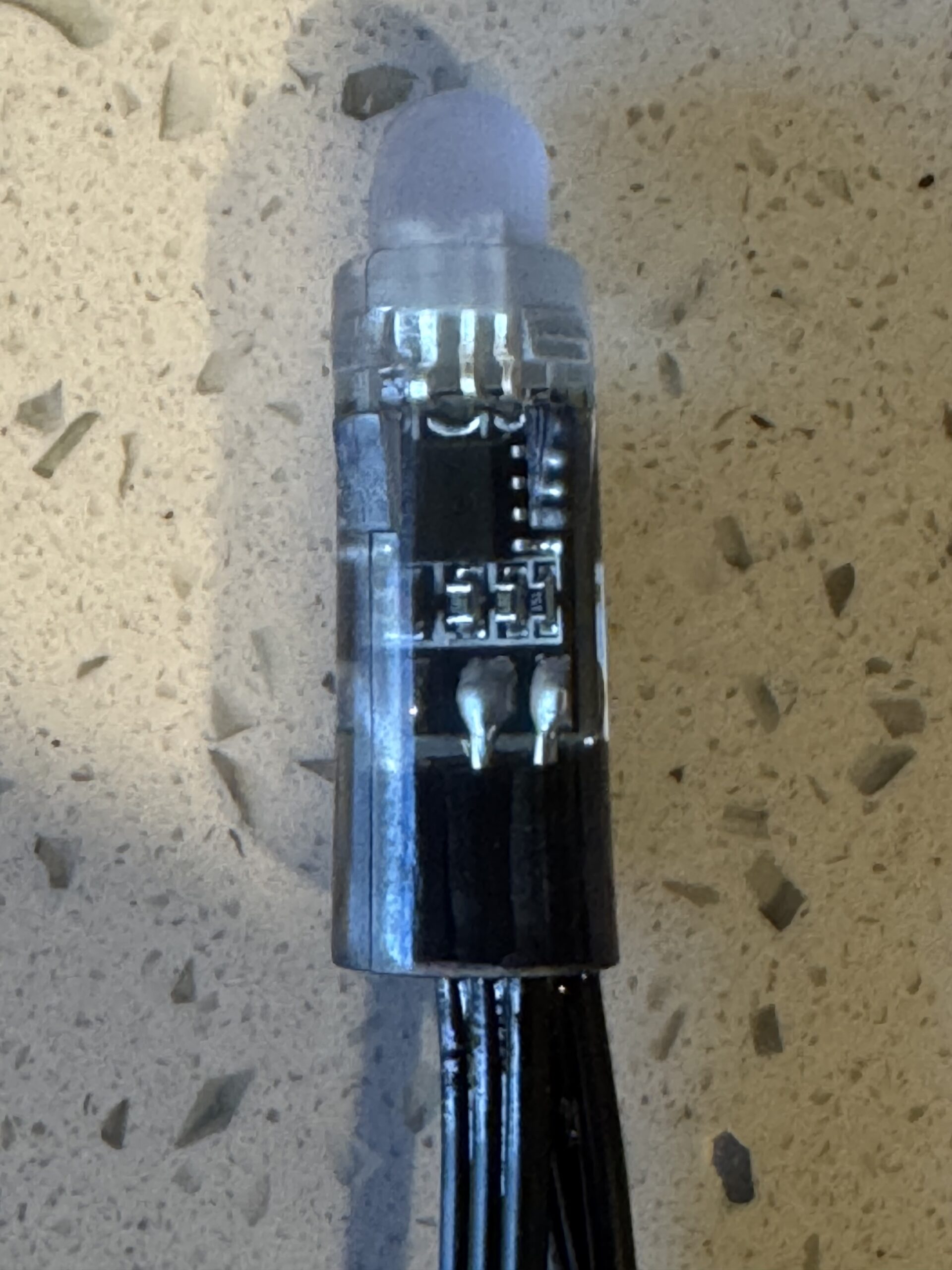 | – Brighter for large displays – Easier to repair – Standard for most builds | – Significantly Heavier – More wind resistance – Higher power consumption – Requires mounting strips (plastic strip with holes for pixels) – More work to build |
Seed pixels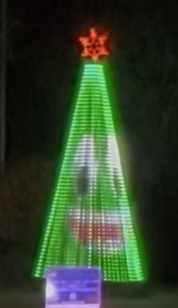 | – Light weight (less sag) – Higher pixel density possible; great for smooth effects – Much more compact for storage – Less expensive per pixel – Significantly lower power consumption – Uses fewer controller ports – No mounting strips needed | – Harder to mount cleanly – strands can get twisted, but there are 3D printed clips on the market that can help with this – Long term durability is sometimes questioned, but may be less of an issue with newer versions of seeds with thicker wire |
What did I do?
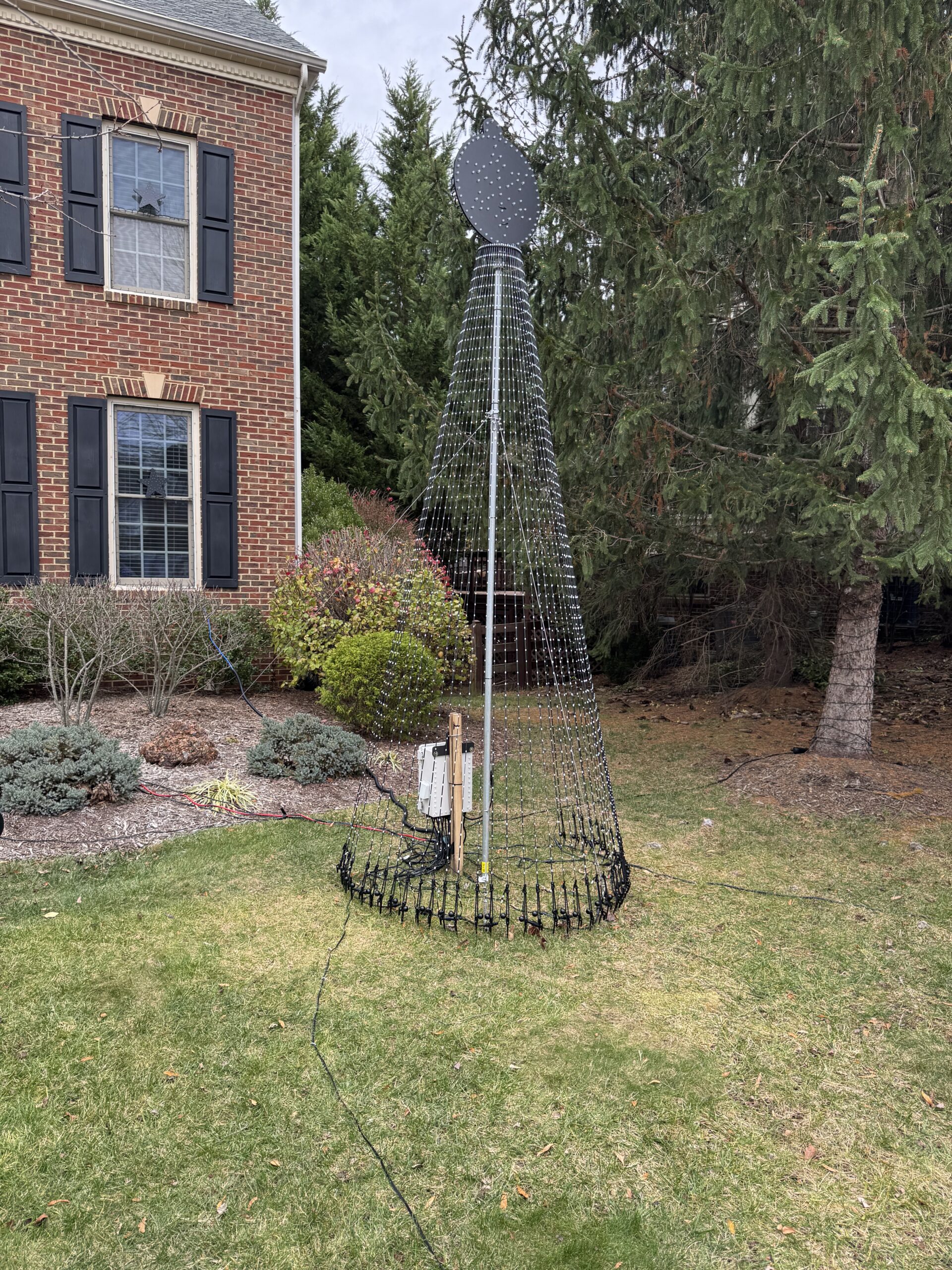
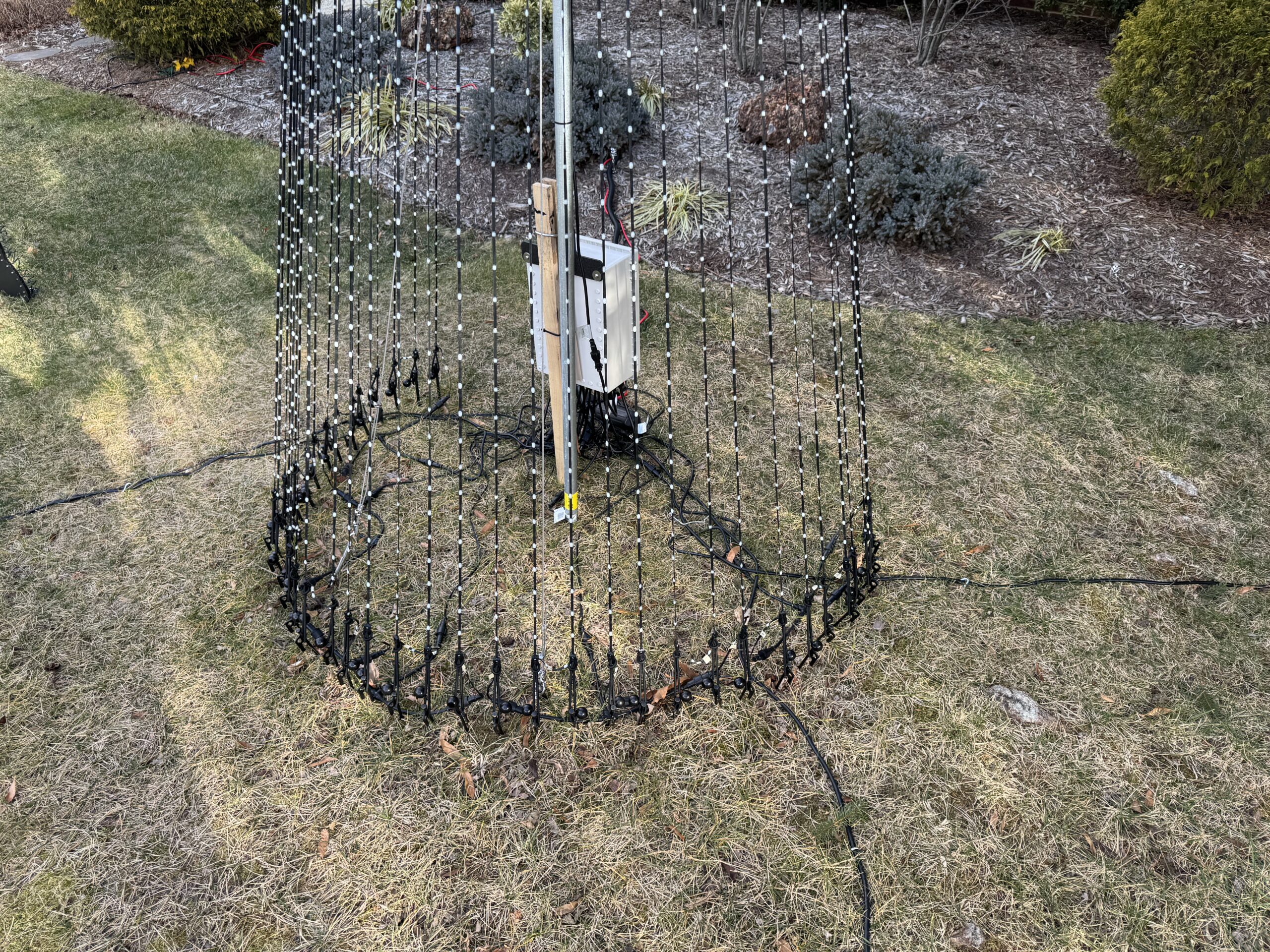
For my MegaTree (photos below), I chose to use seed pixels due to their lower power consumption, lower cost and much easier to store in the off season. My mega tree is relatively small because I have a small yard with existing live trees that I don’t want to hit — it is 10 feet tall without the spinner on top (~12 feet with the spinner). It is also a 225 degree mega tree, meaning the lights don’t go all the way around (open in the back). Depending on your layout, you may want a full 360 degree tree, but in my case it would be a waste of lights in the back. If I were going to do it again, I would think about using 1 inch spaced seed pixels for better resolution/density. For 2026 I plan to hide the controller that you see in the photos. The tree uses 5 ports on a 16 port controller and consists of the following:
- 10 strings of 240 seed pixels with 2 inch spacing (2,400 pixels total) in a “folded” configuration – one 240 pixel string becomes four 60 pixel strands on the tree – for a total of 40 strands of 60 pixels
- Two strings are daisy chained from each of 5 ports, and is power balanced via a tee connected to the start and end of each 480 pixel segment (powered from both ends)
- 64 string BillyGoat topper from PixelParadise USA
- 10 foot 1 inch galvanized steel pipe for center pole (plus 24 inch 3/4 inch pipe to hold the “star”)
- 36 inch x 3/4 inch steel rebar pin (as center stake to support main pole)
- 40 twelve inch steel tent stakes for base “ring” instead of traditional PVC or steel ring
- 4 steel guy wires with turnbuckles
- 2 galvanized “floor flanges” (3/4 inch) to attach topper securely
- 1 inch to 3/4 inch galvanized reducing coupler
- 1 inch 3/4 inch galvanized pipe
- 40 Bungee Balls to tension pixels
- 40 “Seedlink” 3D printed seed pixel clips from PixelParadise USA
Click to enlarge photos
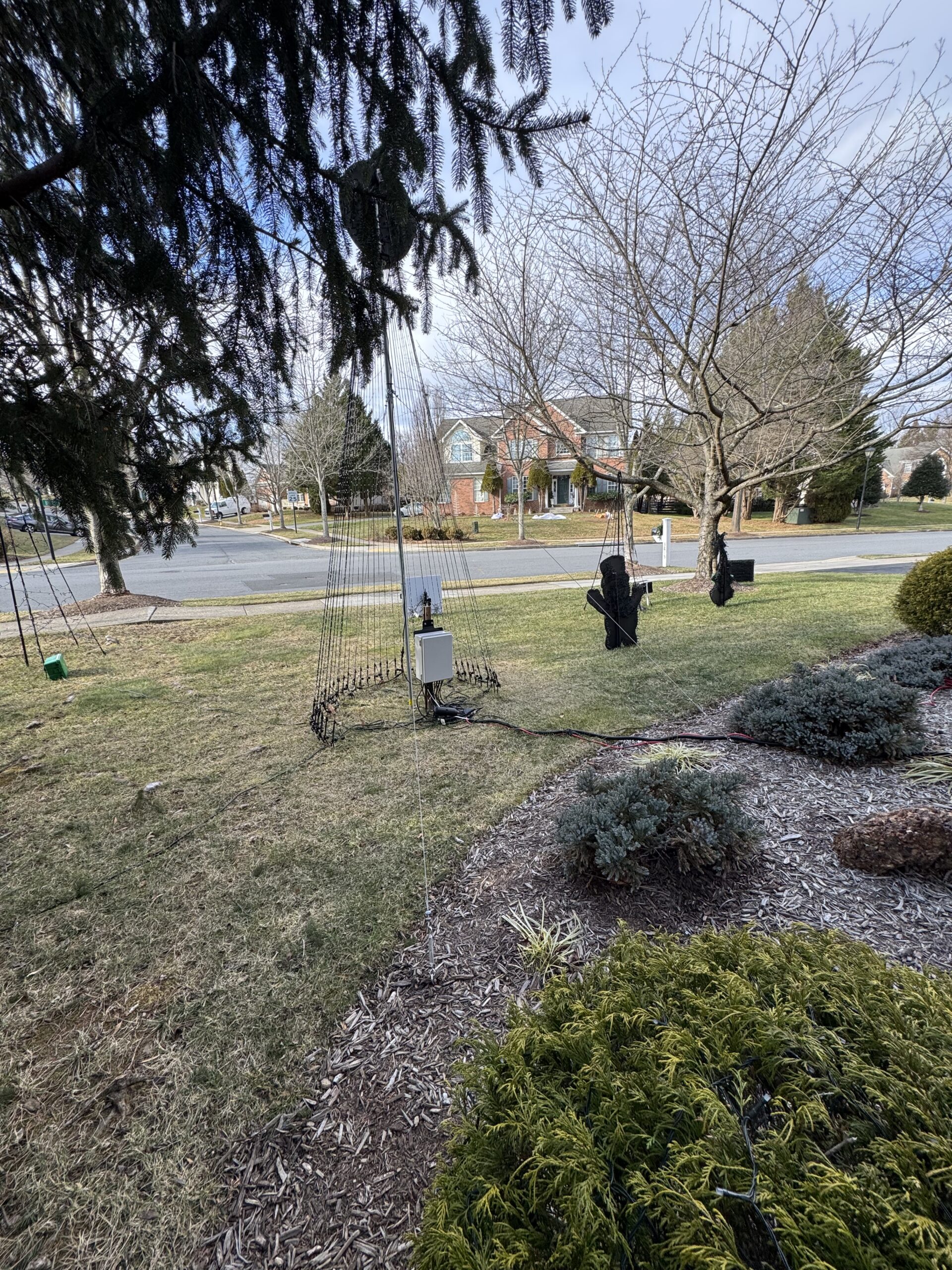
Build Notes / Recommendations
- Be sure to have a stable center pole that can withstand whatever adverse wind / weather conditions could be expected at your location
- Due to the weight of steel pole plus the lights, this could potentially cause property damage or injury if not mounted correctly
- Need to design for your unique soil conditions
- Taller tree generally means thicker pole, if you don’t want it to bend or snap
- Base ring options (this is where light strands attach at bottom of tree):
- Steel ring — usually purchased from lighting vendor, but some folks repurpose mini trampoline frames or similar objects
- PVC ring — usually DIY — use a heat gun to bend PVC into ring
- EMT (Electrical Metallic Tubing) conduit bent into a ring using a pipe bender
- Tent stakes — I used 40 twelve inch steel tent stakes for my “ring” after trying PVC — I really didn’t like how the PVC looked, and the individual stakes combined with bungee balls let me better control tension on each string (but is more work)
- Pole mounting options (center pole):
- Portable bases – either DIY or purchased from lighting vendor — made of wood (DIY) or steel
- In ground PVC sleeves — bury a piece of PVC in the ground with concrete — just drop steel pole into PVC sleeve each season
- Heavy steel stake pounded into the ground as a base, which you slip the pole over — good in heavy clay soil — mine is augmented with guy wires, although this may be overkill
- If digging or pounding in stakes, take care to avoid underground utility lines!
- There are designs out there for taller poles using winch systems to raise the topper
- Design your pole with room at the top for your star (or spinner)!
- If using seed pixels, it’s not super critical for the seeds to all face perfectly forward — even if there’s some twisting the pixels will be visible in the dark
- Many people mount the controller to the center pole; I had mine on a separate stake next to the pole last year, but didn’t like the appearance (see photos); planning to hide the controller behind a large coro prop off to the side of the tree next season
- Use bungee balls to tension your strings of lights to the base ring — you want to keep them under tension so effects look good even if it’s windy
FAQ
Should I try to DIY a mega tree or buy a pre-made setup?
You need to decide this for yourself, based on how comfortable you are with DIY projects and your ability to do this safely. It might be wise to start with a smaller (~10 foot tree) for your first tree to understand how it all works on a more manageable scale before moving onto really large mega trees (20 foot or larger). If you want to spend the money, there are some great commercial solutions out there now that haven’t been available in the past.
Should I build my mega tree with seed pixels or bullet pixels?
This comes down to personal tastes and your particular situation. If you want to see the tree from space or have it set back really far from where the viewers will be, bullets probably make sense because they are brighter. Seeds are much more practical in terms of way less storage space in the off season, less weight, cheaper and use less power (frees up controller ports that you can use for other things). My preference is seed pixels, and I think they probably make more sense for most folks. If using seed pixels you may want to explore using some sort of seed pixel clips like the “Seedlink” 3D printed clips I bought from PixelParadise USA — these give you a good place to attach your bungee ball at the bottom of the strings and keep things straight and orderly.
Do I need a dedicated controller for the mega tree?
No. You can have the same controller running both a MegaTree and other props at the same time. A dedicated controller or using a remote receiver setup from your main controller could make for cleaner wiring, but it’s not strictly necessary.
Where can I buy pre-made mega tree kits?
Take a look at our article on Props & Devices, which includes links for recommended mega tree component vendors.
Could I build a mega tree using Twinkly strings?
You could, however, it would likely be significantly more expensive and probably wouldn’t look as good. Twinkly spaces their pixels on the wires at a little over 3 inches apart, so you wouldn’t get the same light density you can get with seed pixels without some sort of strips. In addition, to get 2,400 pixels on a tree would take four sets of Twinkly 600 strings (at roughly $200 per box) and add four more Twinkly controllers to your WiFi network creating potential latency issues. Wanting to do a MegaTree was actually one of the main reasons I started adding WS2811 style pixels to my show in the first place, as I knew it would be more affordable and work properly right out of the gate!
Is it spelled “MegaTree”, “mega tree”, or “megatree”?
Technically, all of them are correct, but it usually depends on who you are talking to! This site uses them interchangeably.
- “Mega Tree” (or “mega trees”) is the most common conversational spelling used by DIY builders and the general public when searching for layout guides.
- “MegaTree” (or “megatree”) is the technical spelling favored by developers and is what you will typically see inside software menus like xLights or Falcon Player (FPP).
No matter how you choose to spell it, our mega tree calculator is designed to compute the exact physical layout for your holiday mega tree!
What is a “nullstrand” configuration error and how do I fix it?
Take a look at our article on Troubleshooting the “NullStrand” Disconnect: Fixing Null Pixels and String Miscounts in xLights & FPP, which includes a step-by-step troubleshooting guide.
Are Mega Trees just for Christmas?
No! MegaTrees aren’t just for Christmas anymore! Many folks incorporate them into their Halloween displays or use them for other holidays. You can also use the same techniques used in building a MegaTree to build a unique prop which is basically a high density light cylinder, suitable for any holiday, where the top and bottom are the same diameter — this is easy to model in xLights and makes for some cool effects.